Nature-based Solutions (NbS) are often presented as innovative approaches that need to be scaled up and mainstreamed before to become standard practice. At least, that is how I often think. As part of ResiRiver, a programme dedicated to advancing NbS mainstreaming, I was eager to learn how mainstreaming takes shape in practice. The ResiRiver pilot at Bunker Bay, along Germany's River Weser, seemed like the perfect place to do so.
Understanding of mainstreaming
What I did not expect was that the visit would totally challenge my understanding of mainstreaming. What if Nature-based Solutions are already normal?
I realized this when I asked project lead Michaela how lessons from Bunker Bay could be replicated elsewhere. Her reaction caught me off guard: “I don’t know,” she said, somewhat puzzled, “we do this all the time.” In that moment, my carefully framed ‘mainstreaming’ question and perhaps the whole understanding I build in my mind about this project, felt totally out of place.
The measures I saw at Bunker Bay were not experimental innovations waiting to be scaled up. They were familiar, tested approaches that practitioners along the Weser have been applying, refining, and learning from for years. If the knowledge, expertise and practical examples already exist, then what exactly still needs to be mainstreamed?
The story of Bunker Bay suggests that mainstreaming is not always about developing new solutions or transferring knowledge from one place to another. Sometimes it is about recognising, supporting, and creating space for practices that already exist. Join me at Bunker Bay and discover how this site broadened my understanding of what NbS mainstreaming can mean.
Bunker bay: a bay in front of a bunker
Bunker Bay is, quite literally, what its name suggests: a bay situated directly in front of the 30 meter high submarine bunker Valentin. Built by forced labourers during the Second World War, the structure was never completed and not a single submarine was ever produced there. Since 2010, Bunker Valentin serves as a memorial and information centre.
It is not the bunker itself that the ResiRiver team came for, however. The bay, originally intended as a harbour from which submarines would depart for the North Sea, was our focus. In particular the condition of its embankments ignited the project here. Looking across the bay, it is easy to see why. Stones that once stabilised the embankment are now scattered across the bay, a clear sign that its stability is declining.
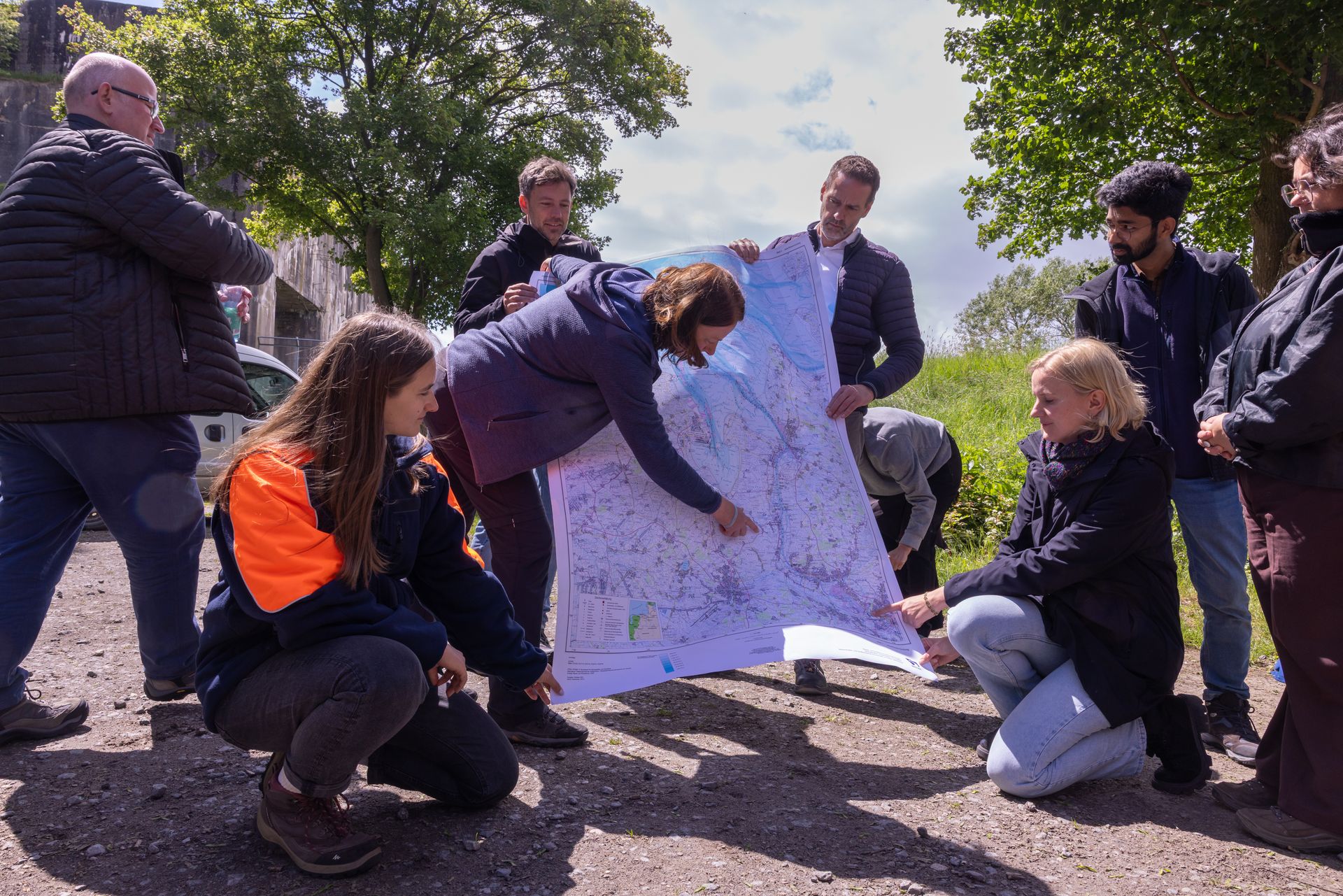
Michaela introducing the Bunker Bay site to the ResiRiver team. Melanie can be seen holding the map in the lower right corner. Photo by Gaby Ahnert.
Reinforcing the bay’s embankment... or not?
The displaced stones are only part of the story. The embankments are exposed to a combination of wave attack, substantial tidal variation approaching four metres, and suction forces induced by passing container ships. Moreover, over time, tidal creeks have developed within the bay and are increasingly undermining the stability. At first site, reinforcing the structure may appear to be the most logical maintenance priority for the Federal Waterways and Shipping Administration (WSV).
Yet the role of the embankments has changed entirely since it was constructed. They no longer protect critical infrastructure, nor are they located along the main navigation channel. WSV's primary responsibility lies elsewhere: maintaining the Weser's shipping route which includes ensuring a navigational depth of 14 metres. Across the river system, many locations compete for limited maintenance budgets and resources.
As a result, Bunker Bay has a relatively low priority. Michaela, working for WSVs local branch office and project lead for Bunker Bay, clarifies the priority even further: "This is very small for us. It's a very, very small measure."
The challenge for this location, therefore, was not to reinforce embankments. The challenge was how to create a situation in which maintenance would no longer be needed at all. For WSV, this is precisely the type of question that encourages looking beyond conventional engineering solutions and towards NbS.
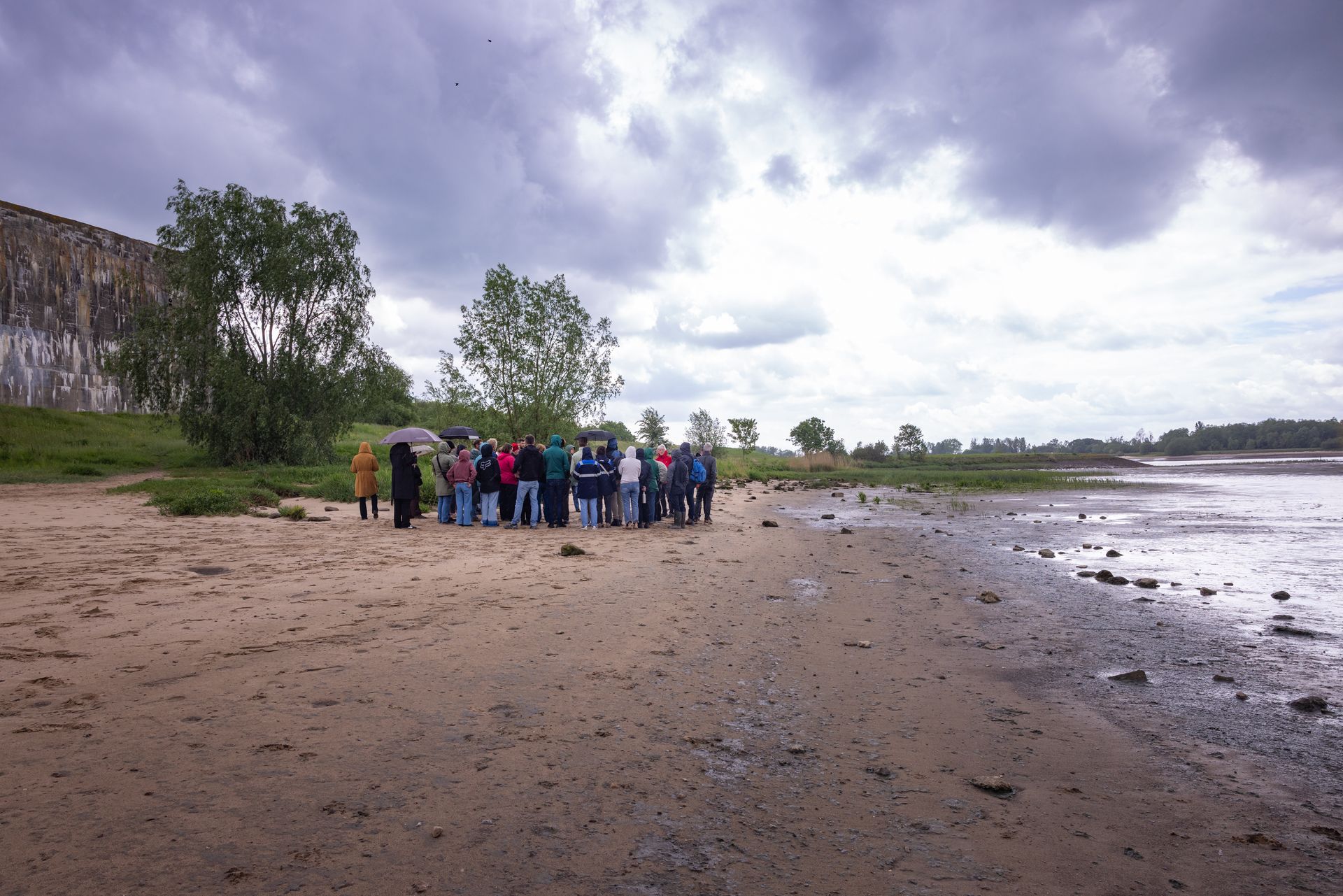
Stones that once stabilised the embankments are now scattered across the bay. Photo by Gaby Ahnert.
NbS: building on a rich knowledge base
This was far from the first time WSV had explored NbS. Over the years, extensive experience has been gained with NbS for bank protection along Germany's three major tidal rivers: the Weser, Elbe and Ems. The German Federal Waterways Engineering and Research Institute (BAW) in collaboration with the Federal Institute of Hydrology (BfG), WSV's scientific partners, documented more than 80 different nature-based measures in an online catalogue, ranging from brushwood structures and vegetated boxes to modified revetments and habitat-enhancement features along with technical guidelines.
One of BAW's leading experts in this field is Isabel Schreiber. When the challenges at Bunker Bay emerged, Michaela picked up the phone and called her. "The goal was to provide additional shelter to the existing revetment by redirecting the tidal creek away from it," Isabel explains. She suggested among others brushwood boxes, an intervention quickly delivering an additional benefit: vegetation began to establish itself. The expectation is that this ecological development will further strengthen the site's resilience. "We expect the vegetation itself to become an additional form of bank protection," Michaela says.
Elsewhere in the bay, a brushwood groyne was constructed to create favourable conditions for characteristic riverbank vegetation, while a large dead-tree structure was installed to reduce flow velocities and increase habitat diversity.
For Michaela, the NbS catalogue is an essential resource. "I often use it to look for ideas," she explains. More importantly, it provides confidence. If a measure has already been tested elsewhere, practitioners can learn from previous experiences, consult factsheets and contact colleagues who have implemented it before. The brushwood groyne, for example, was inspired by a project on the Elbe. "Moritz sent me a factsheet and a lot of photos. We had never built anything like that in this area, but it made me think: perhaps we could give it a try here as well."
The low-risk location in the bay also allows to learn new things on NbS measures. For example about the use of trees for bank protection. Isabel enthusiastically explains: "Large woody debris can pose navigation hazards, so anchoring them safely is essential. Here, we found a way to secure the structure properly, and this can help build confidence for similar measures elsewhere."
While walking along the bay, seeing the brushwood structures, vegetated bank protection and habitat measures I kept looking for the innovative and new NbS part of this story, but I realised it wasn't. These measures had been used, tested and refined for decades, a process that continues until today. The question I asked myself became different. If all this knowledge already exists, what exactly do we mean when we talk about NbS mainstreaming?
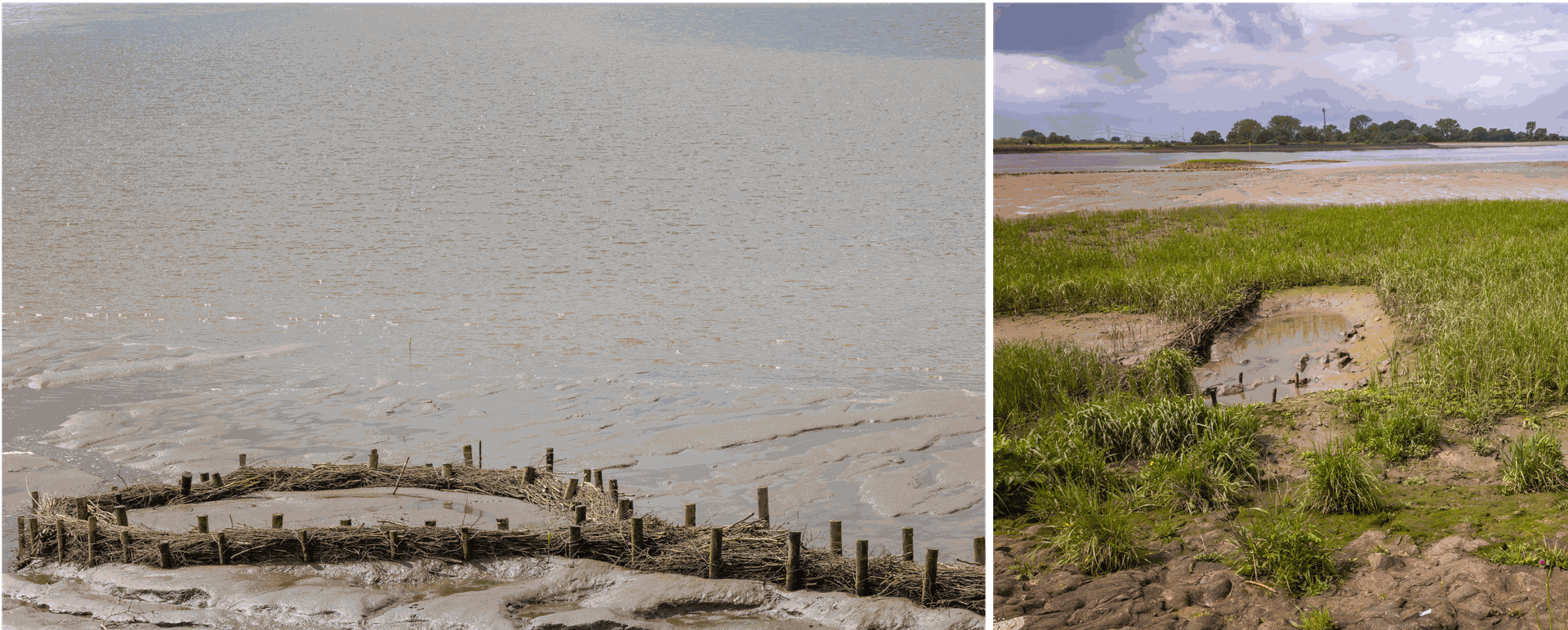
Two different brushwood measures in Bunker Bay. Photos by Gaby Ahnert.
NbS mainstreaming: being allowed to do more
Interestingly, I was not the only person whose assumptions were challenged by Bunker Bay. Silke and Melanie, WSVs representatives within ResiRiver, initially held a similar assumption. Positioned between local branch offices and higher organisational levels within WSV, they wanted to strengthen support for NbS, for which they first turned to the local site.
Like me, what they actually discovered surprised them. At Bunker Bay, and elsewhere, the knowledge on NbS already existed. Local practitioners, like Michaela, were not asking how to implement NbS. They were asking for more opportunities to do so. "Their feedback was: we can't wait to do it. They would love to be allowed to do it more. It was really not a lack of knowledge," Melanie recalls.
As a result, Silke and Melanie shifted their focus. Rather than supporting local branch offices and individual initiatives, they began working to create attention and support at higher organisational levels.
NbS has been largely absent from policy discussions and management agendas. Perhaps the local projects were considered too small to attract attention. Or perhaps bottom-up signals simply struggled to travel through the organisational hierarchy. Whatever the reason, ResiRiver provided an opportunity to make this work more visible.
ResiRiver: a mainstreaming instrument in itself
While for some organisations, international collaboration may be routine, for WSV it carries particular significance. The public meeting held at Bunker Bay is an illustrative example. "We expected people to be critical or ask difficult questions." Melanie recalls, instead however, local stakeholders were pleased that an EU-funded project had taken an interest in their work. Silke noticed the same reaction elsewhere: international attention creates recognition.
This recognition is precisely what Silke and Melanie are trying to use. International collaboration helps raise the profile of local NbS initiatives, giving them visibility within the organisation in ways that would otherwise be difficult to achieve. Through events, newsletters and exchanges with European partners, ResiRiver helps bring local projects to the attention of managers, policymakers and decision-makers.
The programme also strengthens cooperation between organisations. What initially felt like an isolated mission evolved into a broader coalition involving organisations such as BAW and Federal Institute of Hydrology (BfG). "At the beginning I was hesitant about approaching people," Melanie says, "but their response was: totally, what can we do to get involved?"
ResiRiver invests considerable effort in developing tools, educational materials and guidance for mainstreaming. But during my visit, it became clear I found that the programme performs another important function: it is a mainstreaming mechanism in itself.
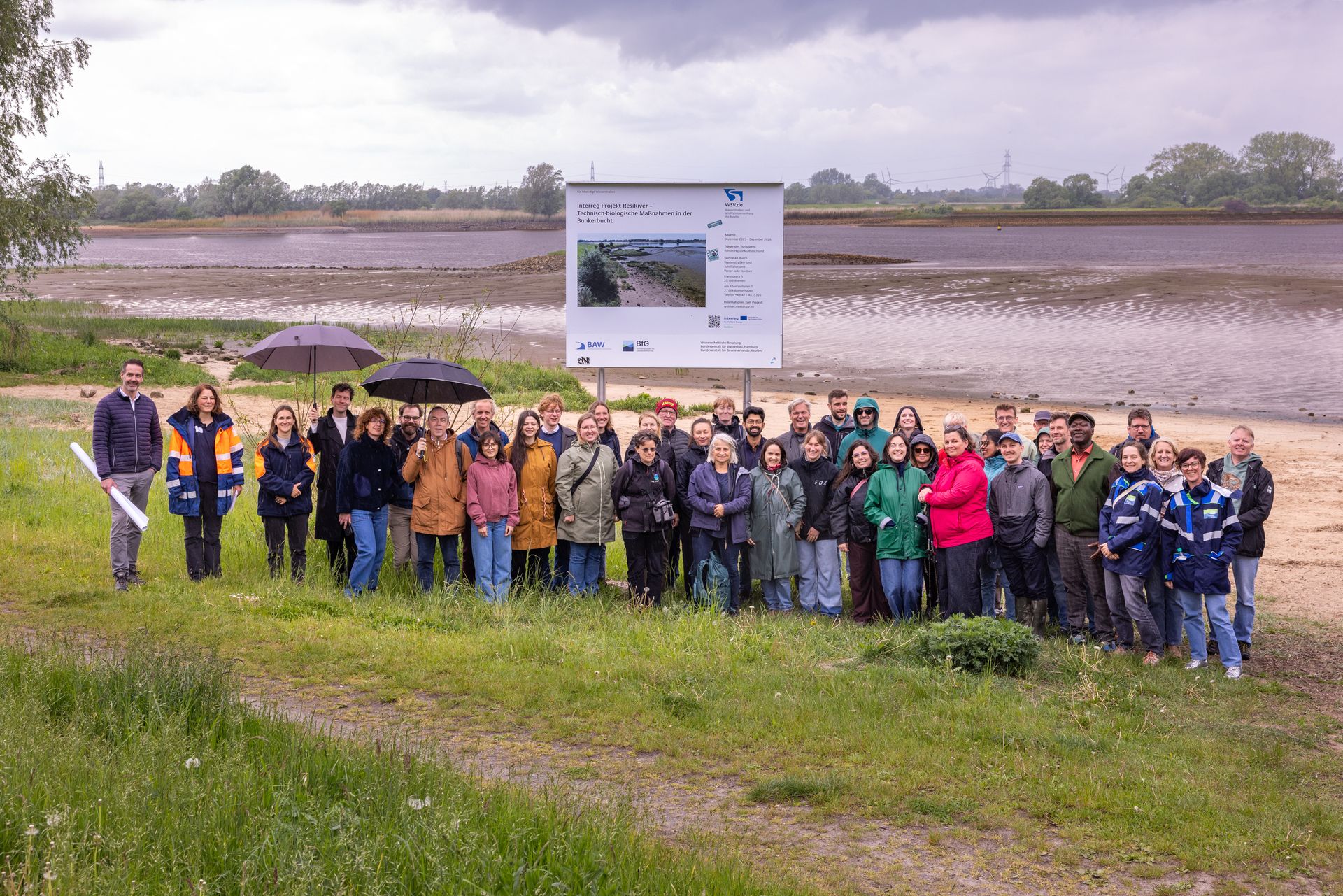
The ResiRiver team in front of the Bunker Bay project sign. International collaboration like ResiRiver can help raise the profile of local NbS initiatives. Photo by Gaby Ahnert.
New perspectives on NbS mainstreaming
NbS mainstreaming is often associated with pioneering pilots and the replication of successful approaches. Going into the field often shows it is much more nuanced and sometimes something entirely different. At Bunker Bay, the necessary knowledge, expertise, and examples are already available. The challenge is not generating new ideas, but putting it on the agenda to enable application more consistently and at a larger scale.
This Bunker Bay story highlights the important role that international programmes can play in mainstreaming. Beyond supporting mainstreaming, the programme creates visibility, connects actors and partners, and provides recognition. In doing so it becomes an active force in the mainstreaming process itself.
Thank you so much Silke Schreier, Melanie Schulz, Michaela Dumm, and Isabel Schreiber for sharing your stories and important work!
Stephanie Janssen regularly writes storylines on mainstreaming NbS. Don't want to miss out on any updates? Check out her LinkedIn page!