What do we actually know about side-channel dynamics? And how can this knowledge help us better implement Nature-based Solutions withing Rijkswaterstaat and international partner projects? Over the past few months, our trainee Auke Dijkstra has been part of the ResiRiver project team, conducting research on side channels in Dutch river systems. The study aims to improve our understanding of their long-term development and support the future implementation of Nature-based Solutions (NbS).
Research objectives and results
Auke and his project team focused on the morphological development of frequently flowing side channels in Dutch rivers. They reviewed existing scientific knowledge on side-channel dynamics and compared it with findings from previous studies. In addition, they assessed the monitoring data available within Rijkswaterstaat to determine how these data could improve our understanding of long-term side-channel development.
The study shows that many of the dominant processes driving side-channel development are relatively well understood. However, uncertainties remain, particularly when predicting long-term development at specific locations and under varying discharges.
Side channels as important Nature-based Solutions
Side channels are an important example of NbS in Dutch river management. They contribute to flood safety, biodiversity and spatial quality. As dynamic systems, they change over time due to natural processes such as erosion, sedimentation and vegetation growth. These processes may change the original design conditions of the side channel and hence the functioning.
For Rijkswaterstaat, this creates challenges for the management and maintenance of side channels. The research therefore explores how lessons from existing projects can support future river restoration measures, including Room for the River 2.0, in which side channels are once again being considered as an important river-management measure.
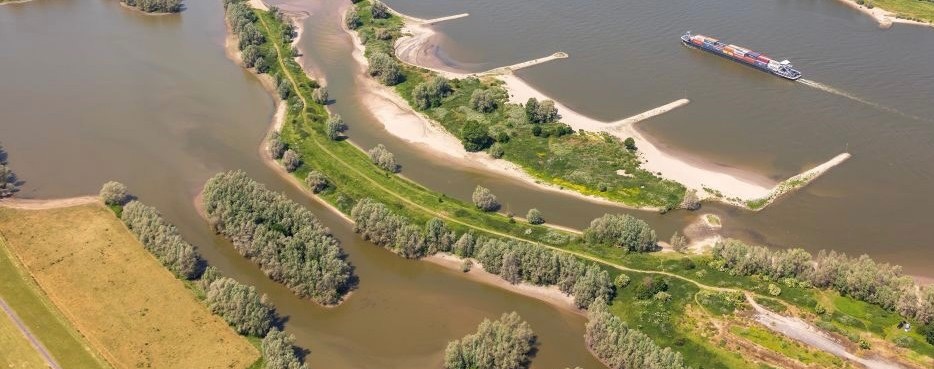 Photo: aerial photo of a side channel in the Gameren Floodplain, by Topview Luchtfotografie
Supporting wider implementation of NbS
By identifying lessons from existing side channels and translating them into practical recommendations, the study contributes to the wider application of NbS. In doing so, the study also contributes to tackling an important barrier to mainstreaming NbS: perceived uncertainty about the long-term development of dynamic natural systems and lack of knowledge on how they can be managed effectively.
The findings are also relevant to comparable river systems in other countries. Several ResiRiver partners face a similar challenge: nature-based, dynamic river interventions can conflict with existing asset-management and maintenance practices. Current management frameworks are often based on fixed standards, thresholds and boundaries, whereas natural systems require a more adaptive and dynamic approach.
The research therefore aims to provide a basis for better accommodating natural processes while continuing to meet safety and operational requirements.
Current status
Auke has completed the first draft and expects to finalise the study within the next two weeks. In early September, he will present the findings to colleagues in Rijkswaterstaat’s flood-safety department.